
June 27, 2026
By: Wole Durodolu, PhD
One timeless biblical principle is that we should never despise the day of small beginnings. Hidden within that wisdom is a lesson Nigeria urgently needs to embrace. Perhaps one of the reasons poverty continues to persist in our society is that too many people aspire to start at the top rather than patiently build from the bottom.
Recently, Nigeria’s First Lady, Senator Oluremi Tinubu, encouraged young people to embrace entrepreneurship, including small-scale businesses, as a pathway to self-reliance instead of depending solely on government employment. While her remarks generated considerable public debate, they also exposed a deeper issue: many Nigerians still view government as the ultimate provider of prosperity.
Our society is deeply religious, and faith has shaped our values in profound ways. However, there is a difference between the realm of miracles and the realities of economic development. Governments can create opportunities, provide infrastructure, formulate sound policies, and stimulate economic growth, but they cannot manufacture prosperity for every individual overnight. Just as no skyscraper rises without first laying a solid foundation, no enduring success is achieved without humble beginnings.
Ironically, many Nigerians who relocate abroad quickly adapt to this reality. Highly educated professionals often accept jobs as taxi drivers, caregivers, warehouse workers, cleaners, or mortuary attendants while working towards their long-term goals. Yet, the very same occupations are sometimes dismissed as beneath their dignity when available at home. This contradiction suggests that the challenge is not simply unemployment but also our perception of work.
Unfortunately, many people interpreted the First Lady’s encouragement to support small businesses as an attempt to lower their aspirations. In reality, every thriving enterprise begins somewhere. Every multinational corporation was once a modest start-up. Entrepreneurship is not about the size of the beginning but about the vision, discipline, and persistence behind it.
I learned this lesson quite early in life. As a student at Olivet Baptist High School, Oyo, I enrolled in Woodwork. However, I later dropped the subject because classmates mocked me, insisting that learning woodworking meant I would become “just a carpenter.” Like many young people, I allowed public opinion to shape my choices.
Years later, after graduating from university, I applied for a job in a furniture showroom in Abuja. By then, I had discovered that those once referred to merely as carpenters had transformed themselves into respected furniture manufacturers, interior designers, and entrepreneurs. Ironically, I could not secure the position because the employer preferred candidates with marketing experience. That experience taught me that practical skills often create opportunities that academic qualifications alone cannot.
There are countless examples of people who transformed humble beginnings into extraordinary success. Ibukun Awosika built one of Africa’s most respected furniture manufacturing companies and became one of the continent’s most accomplished business leaders. Her story demonstrates that craftsmanship, innovation, and entrepreneurship can lead to remarkable achievements.
Another inspiring example is Ayodeji Megbope, founder of No Left-Overs Nigeria Limited. She began with just ₦1,000, selling moin-moin at the gate of a school in Lagos. Through dedication, quality service, and sound business management, she expanded her enterprise into a multimillion-naira catering company serving major corporate organisations. Her entrepreneurial success earned her international recognition, including an invitation to the White House during the administration of former First Lady Michelle Obama.
The same principle is evident globally. At the age of seventeen, Ingvar Kamprad established IKEA with a modest amount of seed capital provided by his father. Guided by the vision of making quality furniture affordable to ordinary people, he revolutionised the furniture industry through innovation, efficiency, and perseverance. IKEA eventually became one of the world’s largest furniture retailers, and Kamprad ranked among the wealthiest individuals on the planet. His success did not begin with enormous capital but with an ordinary idea pursued with extraordinary commitment.
Nigeria also possesses abundant indigenous skills that remain underutilised. Take Adire, for example—a textile tradition that originated among the Yoruba people. Today, manufacturers in China reproduce Adire-inspired designs using advanced industrial technology and export them worldwide, including back to Nigeria. While others are commercialising our cultural heritage on a massive scale, many Nigerians continue to overlook the enormous economic potential embedded in indigenous crafts and creative industries.
This is not an argument against higher education. As someone who values education and has earned multiple academic qualifications, I firmly believe universities remain indispensable institutions for national development. Nevertheless, education should not be narrowly defined by certificates alone. Degrees open doors, but skills, innovation, creativity, and entrepreneurship often determine how far one ultimately goes.
There are many roads to success. Society should never write off individuals because they did not attend university, nor should graduates believe that success lies exclusively in white-collar employment. Some of the world’s most influential entrepreneurs built global enterprises through practical skills, resilience, and business acumen rather than academic credentials alone.
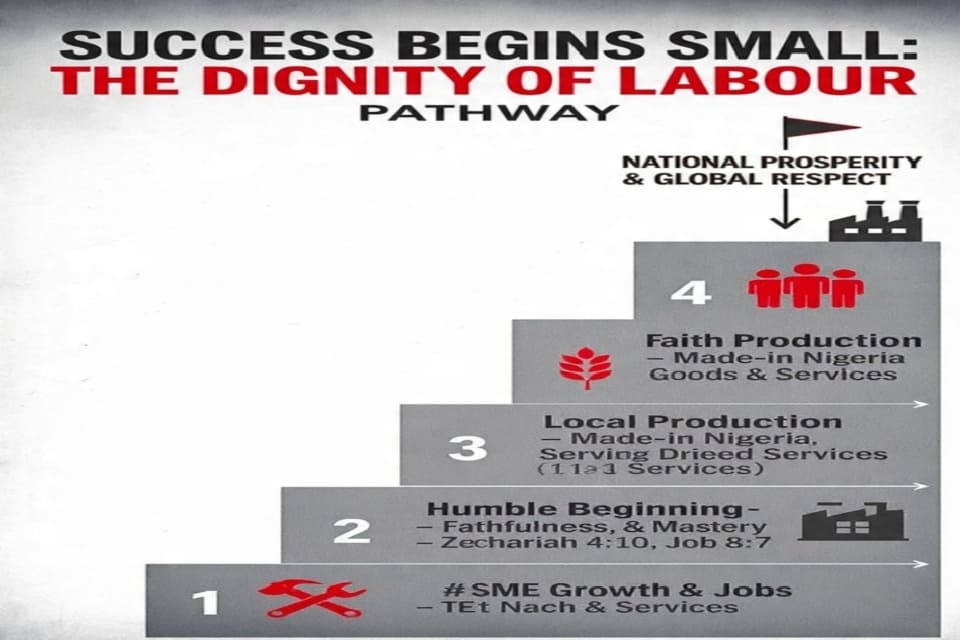
Nigeria’s future depends not only on producing more graduates but also on nurturing more creators, innovators, artisans, manufacturers, and entrepreneurs. We must restore the dignity of labour and encourage young people to see opportunity where others see limitation.
No honest work is too small. Every great business was once a small enterprise. Every successful entrepreneur was once an unknown beginner. The journey to greatness does not begin with grandeur; it begins with the courage to start.
If we embrace that truth, we will not only create jobs for ourselves but also build a stronger, more productive, and more prosperous Nigeria.
