
By Dr. Wole Durodolu
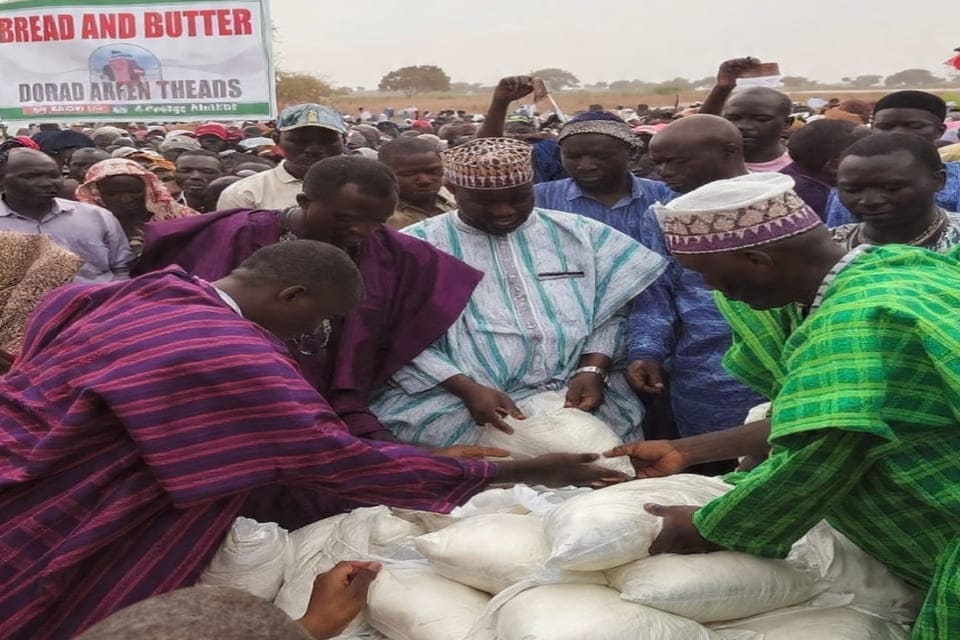
We face a situation in which leadership has been reduced largely to the distribution of “bread and butter,” making a sophisticated intellectual discussion of microeconomics difficult to reconcile with the everyday realities and understanding of many people.
This difficult socioeconomic environment has created the conditions in which individuals such as Ademola Adeleke can contest and win political office in Nigeria. Osun State remains one of the poorest states in the South-West, despite its enormous mineral resources, including substantial gold deposits. The fundamental question is whether the leadership possesses the intellectual and managerial capacity to transform these resources into sustainable wealth, industrial development, employment and improved living standards for the people.
A significant part of the support for the governor appears to be based on the regular payment of workers’ salaries. While this is certainly important, it is equally important for citizens to understand the broader fiscal structure that makes such payments possible. State governments depend substantially on allocations from the Federal Government. For example, Osun State receives billions of naira monthly through federal allocations. Therefore, attributing the state’s ability to meet its recurrent obligations solely to the performance of the state government without considering the federal fiscal structure provides only part of the picture.
This reflects a deeper problem in our political culture: many citizens understandably evaluate government primarily through the lens of immediate survival rather than long-term economic transformation. When people are struggling to meet their daily needs, concepts such as internally generated revenue, fiscal federalism, productivity, industrialisation, resource control and intergovernmental transfers may appear distant from their lived realities. Consequently, even a highly capable politician can be pressured by the system to operate at the level of immediate expectations rather than long-term development.
This is why performance measurement in Nigeria should not be approached as though all states operate under identical economic, institutional and demographic conditions. Lagos State, for instance, possesses a fundamentally different economic structure and revenue-generating capacity from many other states. Yet a significant proportion of the resources generated within economically productive states is redistributed through the federal system. While fiscal redistribution is necessary to promote national cohesion and reduce regional inequality, it can also create weak incentives for states to develop their productive capacity when such transfers become a substitute for internally generated economic activity.
Unfortunately, many Nigerians do not see the complete cause-and-effect relationship within this system. In some parts of the country, the most visible achievements of governors may be limited to social and religious programmes, such as sponsoring pilgrimages, organising mass weddings, or distributing household items. While such interventions may provide immediate relief to beneficiaries, they do not necessarily constitute a comprehensive strategy for industrialisation, wealth creation, human-capital development or sustainable economic transformation.
My argument, therefore, is not simply about the personality or intellectual capacity of any particular governor. It is fundamentally about the structure of governance itself. Nigeria’s present political and fiscal arrangement often makes it difficult to hold leaders accountable for economic performance because states operate within markedly different resource bases, institutional capacities and economic environments.
This is one reason I strongly advocate regionalism. A more decentralised regional structure could encourage states and regions to leverage their comparative advantages, control and develop their resources more effectively, compete economically, invest in infrastructure and human capital, and take greater responsibility for their own development. Regionalism, in this sense, should not be understood merely as an ethnic arrangement; rather, it should be seen as a framework for fiscal responsibility, economic competition, resource optimisation and more effective governance.
Ultimately, Nigeria needs a political system that moves beyond the politics of immediate consumption towards one that rewards productivity, innovation, accountability and sustainable wealth creation. Until we address the structural foundations of our governance system, individual intelligence or political competence alone may not be sufficient to produce the transformation we desire.
